New Association report provides a demographic profile of the restaurant workforce
The restaurant and foodservice industry is the nation’s second largest private sector employer, providing 15.7 million jobs – or 10% of the total U.S. workforce.
This includes 12.5 million jobs at eating and drinking places, plus an estimated 3.2 million foodservice jobs in other sectors such as healthcare, accommodations, education, food-and-beverage stores, and arts, entertainment and recreation.
With millions of employment opportunities available in communities across the country, it’s not surprising that the restaurant industry has played a role in the career path of most people.
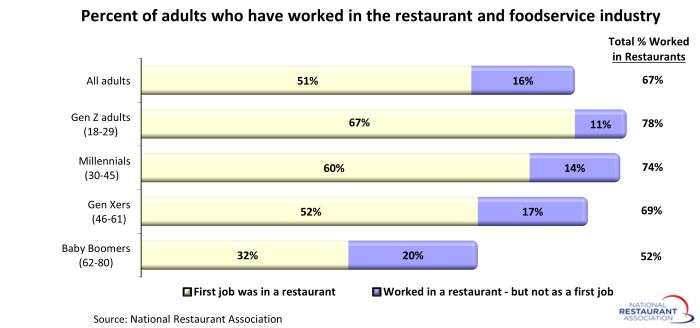
67% of adults say they have worked in the U.S. restaurant and foodservice industry at some point in their lives, according to a National Restaurant Association survey. That is higher than any other sector, which means more adults have worked in restaurants than in any other industry.
A strong majority of Gen Z adults (78%), millennials (74%) and Gen Xers (69%) say they have worked in a restaurant. Even a majority of baby boomers (52%) can put a restaurant or foodservice job on their resume.
In addition to being a source of employment for many people during their careers, restaurants have long been the primary training ground for new entrants to the workforce. 51% of adults say their first regular job was in the restaurant and foodservice industry.
Gen Z adults (67%) and millennials (60%) are the most likely to say they got their first work experience in the restaurant and foodservice industry. Restaurants also provided the first job for 52% of Gen Xers and 32% of baby boomers.
Who works in the U.S. restaurant industry?
To drill down even further, a new National Restaurant Association Data Brief provides a detailed profile of the employees that work in these 15.7 million jobs. Based on data from the U.S. Census Bureau’s American Community Survey, the report contains demographic snapshots for seven restaurant occupations, as well as the overall industry workforce.
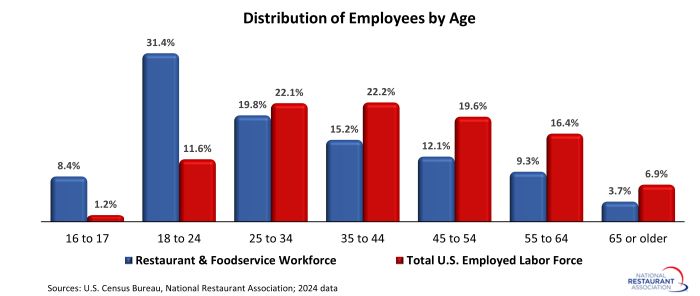
In general, restaurant and foodservice employees tend to be younger and more diverse than the overall U.S. workforce.
This holds true across all occupations, including managers and supervisors. As a result, the restaurant industry employs more minority and female managers than any other sector in the economy.
Restaurant and foodservice employees are also three times more likely than the total U.S. workforce to be under the age of 25.
Other highlights:
- 27% of restaurant employees are enrolled in school.
- More than 6 in 10 restaurant employees have never been married.
- Only 1 in 3 restaurant employees are heads of their household.
- 23% of restaurant employees were born outside of the United States.
- 3 in 10 restaurant employees speak a language other than English at home.
The restaurant and foodservice workforce will continue to grow in the years ahead, with the Association expecting the total number of employees to reach 17.3 million by 2036. Download the Association’s 2026 State of the Restaurant Industry report for the latest workforce trends, including projections for the industry’s prime labor pool in the coming years.