Articles
March 19, 2026
Korsmo, Kennedy share lobbying tactics at Public Affairs Conference
Association’s leaders speak to industry’s challenges and advocacy plans to mitigate them.
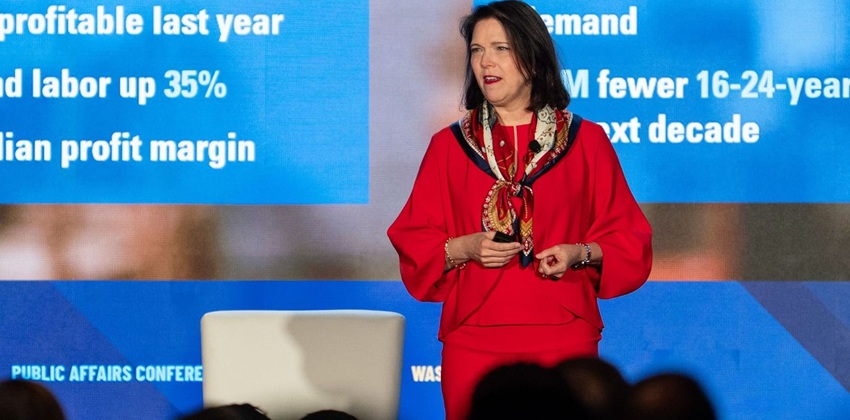
Korsmo said that if restaurants are going to be successful, they’ve got to unleash breakthrough efficiencies to help their 3% profit margins.
The restaurant and hospitality industry plays a critical role as a driver of the U.S. economy and as a cornerstone of communities across the country. It also plays an important role in influencing the policies and legislation that regulate its businesses.
As economic and trade issues continue to impact profitability, advocating for restaurants was especially top of mind at this year’s Restaurants Act Public Affairs Conference in Washington, D.C. It provided industry members with a forum to lay the groundwork for the next round of policy victories.
According to Korsmo, the impact the Administration’s tariff and immigration policies are having on the industry is biting into its ability to prosper and grow. She shared the following key takeaways from the Association’s 2026 State of the Restaurant Industry report:
He thanked industry and state restaurant association members who’ve engaged in the efforts to educate lawmakers on the effects their legislation has on restaurant businesses, saying their input was responsible for some of the tax reforms in legislation last year, and that their help is, again, needed now to sway lawmakers’ decisions on swipe fees and immigration reform.
“We need your voices and stories, your presence as operators who understand first-hand what this industry needs to thrive,” he said. “So, let’s keep going. Let’s shape policy, opportunity, and the future of millions of workers and their families. Let’s dive into the work; we have a lot to accomplish.”
Cretella reinforced the advocacy strategy that proved so effective last year: operator stories, backed by data, move lawmakers. She reminded attendees that Members of Congress respond to real-world impacts more than abstract policy arguments. The personal narratives shared at last year’s PAFC helped pave the way for meaningful tax reform—and, she emphasized, the same approach would be essential for winning relief on swipe fees, advancing immigration modernization, and ensuring a constructive USMCA review.
"Talk to them about your own experiences,” she said. “Tell them your stories but also have data to back them up. It's up to us to ensure they understand what our challenges are and what will allow us to become stronger, hire new people and open doors for them.”
Korsmo, Kennedy, and Cretella made clear that advocacy wins don’t happen in isolation—they begin at PAFC, powered by operators willing to show up and tell their stories. Last year proved the strength of that formula. This year, the industry once again set the stage for meaningful progress on the issues that matter most.
As economic and trade issues continue to impact profitability, advocating for restaurants was especially top of mind at this year’s Restaurants Act Public Affairs Conference in Washington, D.C. It provided industry members with a forum to lay the groundwork for the next round of policy victories.
Unleashing breakthrough efficiencies
The conference’s speakers, which included Association President & CEO Michelle Korsmo, Public Affairs Executive Vice President Sean Kennedy, and Association Vice Chair Jeanne Cretella, Co-Founder and President of restaurant operator by Landmark, emphasized that despite employing 15.7 million people and contributing $3.6 trillion in direct and indirect economic impacts, the industry is facing headwinds, such as increased food and labor costs, low profit margins, and workforce shortages. To succeed, they said, operators must focus on two major imperatives:- Unleashing breakthrough efficiencies to help with tight profit margins
- Empowering a future ready workforce through training and skill-building that will build a strong pipeline of talent
According to Korsmo, the impact the Administration’s tariff and immigration policies are having on the industry is biting into its ability to prosper and grow. She shared the following key takeaways from the Association’s 2026 State of the Restaurant Industry report:
- 42% of operators indicate their restaurants were not profitable this past year due to higher costs and lower profit margins
- Food and labor costs have increased more than 35% since 2020, and profit margins remain at about 3% across all sectors
- 25% of restaurant operators say they don’t have enough staff to meet customer demand
- Just 2.1 million 16-to-24-year-olds—an important part of the industry’s workforce—will enter the workforce over the next 10 years
- 9 in 10 customers say they love restaurant staff and enjoy going to restaurants
Immigration reform and swipe fees top policy agenda
Kennedy talked about the Association’s advocacy efforts to influence policy initiatives that support the industry. These include comprehensive immigration reform and reducing the out-of-control credit card swipe fees that are squeezing restaurateurs and causing operational pressures. He noted that the policy team is currently lobbying for a successful review of the USMCA trade agreement that would keep access to food and beverage products from Mexico and Canada affordable and staying on top of the Administration’s Make America Healthy Again (MAHA) movement’s agenda.He thanked industry and state restaurant association members who’ve engaged in the efforts to educate lawmakers on the effects their legislation has on restaurant businesses, saying their input was responsible for some of the tax reforms in legislation last year, and that their help is, again, needed now to sway lawmakers’ decisions on swipe fees and immigration reform.
“We need your voices and stories, your presence as operators who understand first-hand what this industry needs to thrive,” he said. “So, let’s keep going. Let’s shape policy, opportunity, and the future of millions of workers and their families. Let’s dive into the work; we have a lot to accomplish.”
Cretella reinforced the advocacy strategy that proved so effective last year: operator stories, backed by data, move lawmakers. She reminded attendees that Members of Congress respond to real-world impacts more than abstract policy arguments. The personal narratives shared at last year’s PAFC helped pave the way for meaningful tax reform—and, she emphasized, the same approach would be essential for winning relief on swipe fees, advancing immigration modernization, and ensuring a constructive USMCA review.
"Talk to them about your own experiences,” she said. “Tell them your stories but also have data to back them up. It's up to us to ensure they understand what our challenges are and what will allow us to become stronger, hire new people and open doors for them.”
Korsmo, Kennedy, and Cretella made clear that advocacy wins don’t happen in isolation—they begin at PAFC, powered by operators willing to show up and tell their stories. Last year proved the strength of that formula. This year, the industry once again set the stage for meaningful progress on the issues that matter most.
Sign up for our Newsletter
The latest news from the National Restaurant Association, published every other Thursday
By clicking Submit I agree to receive email communications from the National Restaurant Association and agree to our Privacy Policy(Opens in a new window).