Elevated costs continue to pressure restaurant profitability
Steadily rising costs have been a defining characteristic of the restaurant business environment during the last several years. Many factors contributed to these cost increases, including pandemic-era supply chain disruptions, labor shortages, trade policy fluctuations and challenges in food commodity markets.
While the growth rates of most restaurant expenses have moderated somewhat from the 2021 and 2022 peaks, they remain elevated compared to pre-pandemic levels. That puts continued pressure on margins, which means operators need to be focused on improving efficiency and productivity across their operations while identifying opportunities to manage costs.
This article illustrates the impact that higher costs have on an average restaurant’s bottom line. It also shows the extent to which sales have to rise for restaurants to be able to ‘grow’ their way out of higher input costs.
Baseline view of the bottom line
Prior to the pandemic, the cost breakdown for a typical independent restaurant looked like this:
- Food and labor costs were the two most significant line items, each accounting for approximately 33 cents of every dollar in sales.
- Other expenses – such as utilities, occupancy, supplies, general/administrative, repairs/maintenance and credit card processing fees – combined to represent about 29% of sales.
That left a pre-tax profit margin of roughly 5% for a typical restaurant, which means significant cost increases were not sustainable.
Based on government data and surveys of operators, restaurant expenses rose sharply across all major categories since 2019 – led by significant gains in both food and labor costs. Average hourly earnings of restaurant employees jumped 41% from pre-pandemic levels, while average wholesale food prices were up 35%.
At the same time, operators were also contending with sharply higher expenses for utilities, occupancy, supplies and credit card swipe fees – all of which registered double-digit percent increases since 2019.
Overall, the National Restaurant Association estimates that total expenses for an average restaurant jumped 36% between 2019 and 2026.
With that as a backdrop, it’s not surprising that 42% of operators said their restaurant was not profitable in 2025.
The charts below illustrate the impact that these higher input costs would have on an average restaurant’s bottom line. As would be expected, the impact varies significantly depending on a restaurant’s current sales compared to pre-pandemic levels.
Impact on the bottom line without higher sales
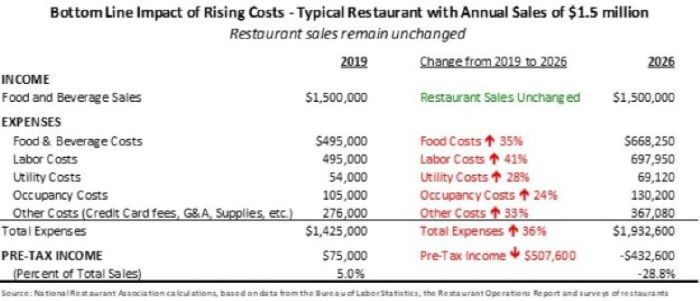
Prior to the cost increases during the last several years, pre-tax income represented 5% of sales for this restaurant, or $75,000.
If sales remained unchanged from 2019 levels, the restaurant would register a pre-tax loss of $432,600, or nearly 29% of sales.
Sales increase required to break even
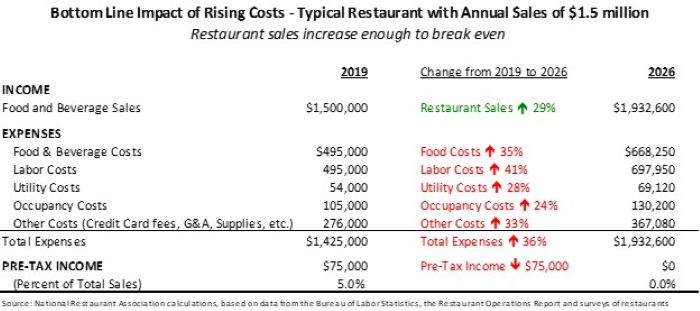
To cover its added costs and not suffer a loss, this restaurant’s total sales would have to increase to $1,932,600 – or 29% above 2019’s sales volume.
However, that would only mean breaking even, with no profitability.
Sales increase required to maintain a 5% profit margin
Most restaurants can’t simply break even, as debt burdens in the industry are still elevated from the pandemic. To pay off this debt, restaurants need to make a profit.
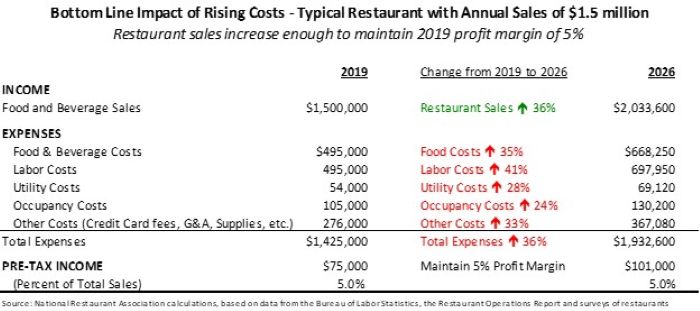
To cover the higher input costs and maintain its 5% pre-pandemic profit margin, this restaurant’s total sales would have to increase to $2,033,600 – or 36% above 2019’s sales volume.
Impact of menu prices on sales growth
With customer traffic levels dampened across much of the industry, increases in menu prices were responsible for a sizable portion of sales growth in recent years. As a result, the extent to which restaurants can grow their way out of higher costs has largely been contingent on their ability to increase prices.
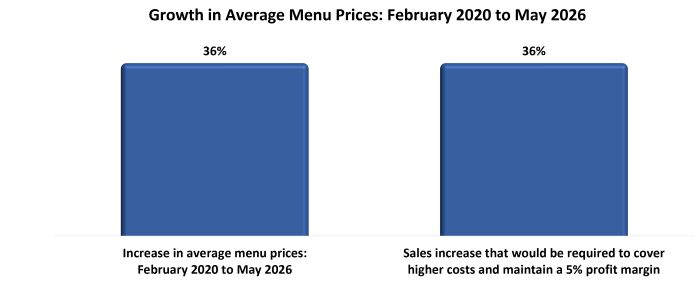
Average menu prices increased 36% between February 2020 and May 2026, according to data from the Bureau of Labor Statistics. That is on par with the sales increase that the average restaurant would need to cover its higher costs and maintain the 5% profit margin that it had before the pandemic.