Research
October 19, 2026
Restaurant sales volume revised lower based on benchmarked government data
New data indicate a slower recovery from the pandemic than originally reported
The U.S. Census Bureau’s latest monthly retail sales report – released last Thursday – showed continued resilience among consumers. Eating and drinking place sales rose for the 8th consecutive month in September, as consumers continued to prioritize restaurants in their spending decisions.
The Census Bureau’s annual revisions to the data were also incorporated into the latest sales report. For the first time, the monthly survey-based sales estimates were benchmarked to the Annual Integrated Economic Survey (AIES). The AIES replaced and integrated seven business surveys into one survey that provides comprehensive annual data on business activity in the U.S.
This Census Bureau data program is important because it represents a key building block for the National Restaurant Association’s estimates and projections of restaurant and foodservice sales in the U.S.
The Census Bureau’s data benchmark last week resulted in a significant downward revision in the total volume of eating and drinking place sales, which in turn impacted the Association’s sales estimates.
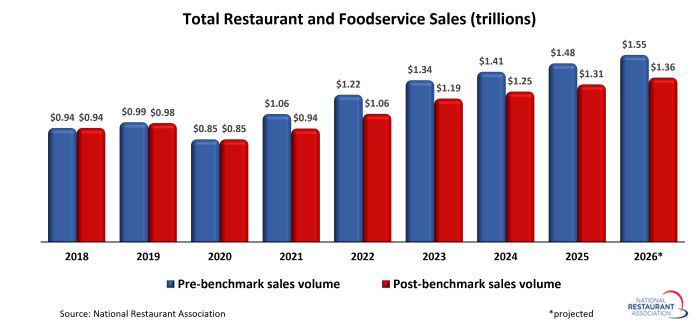
Prior to the benchmark, the Association expected restaurant and foodservice sales to total $1.55 trillion in 2026. After the Census Bureau’s benchmark revisions, that number dropped to $1.36 trillion.
The most significant changes to restaurant sales volume began in 2021, as illustrated in the chart below. Based on the revised data, the industry’s recovery from the pandemic was much slower than originally reported.
Prior to the revisions, restaurant and foodservice sales totaled $1.06 trillion in 2021, a 24% increase from 2020. The revised data showed an increase of just 11% in 2021, with sales totaling $940 billion. That gap continued to widen in the years that followed, as revised data indicated a slower post-pandemic growth rate.
Note that the projected 2026 growth rate remains intact. The Association expects total restaurant and foodservice sales to increase 4.3% in 2026. In inflation-adjusted terms, sales are projected to rise 0.8%.
The Census Bureau’s annual revisions to the data were also incorporated into the latest sales report. For the first time, the monthly survey-based sales estimates were benchmarked to the Annual Integrated Economic Survey (AIES). The AIES replaced and integrated seven business surveys into one survey that provides comprehensive annual data on business activity in the U.S.
This Census Bureau data program is important because it represents a key building block for the National Restaurant Association’s estimates and projections of restaurant and foodservice sales in the U.S.
The Census Bureau’s data benchmark last week resulted in a significant downward revision in the total volume of eating and drinking place sales, which in turn impacted the Association’s sales estimates.
Prior to the benchmark, the Association expected restaurant and foodservice sales to total $1.55 trillion in 2026. After the Census Bureau’s benchmark revisions, that number dropped to $1.36 trillion.
The most significant changes to restaurant sales volume began in 2021, as illustrated in the chart below. Based on the revised data, the industry’s recovery from the pandemic was much slower than originally reported.
Prior to the revisions, restaurant and foodservice sales totaled $1.06 trillion in 2021, a 24% increase from 2020. The revised data showed an increase of just 11% in 2021, with sales totaling $940 billion. That gap continued to widen in the years that followed, as revised data indicated a slower post-pandemic growth rate.
Note that the projected 2026 growth rate remains intact. The Association expects total restaurant and foodservice sales to increase 4.3% in 2026. In inflation-adjusted terms, sales are projected to rise 0.8%.