Research
September 16, 2026
Monetary Policy
Federal Reserve hikes interest rates for the first time since July 2023
At its September 15-16 meeting, the Federal Open Market Committee (FOMC) raised short-term interest rates for the first time since July 2023, reversing an easing cycle that began two years ago. The decision largely reflects the Federal Reserve's effort to stay ahead of inflationary pressures, which have remained elevated and generally moved higher for much of this year. The target federal funds rate now stands at 3.75% to 4.00%. The decision was unanimous among FOMC voting members.
Financial markets had widely anticipated the move. In recent weeks, Federal Reserve Chair Kevin Warsh signaled the central bank's willingness to take appropriate action to preserve price stability, one of the Federal Reserve's dual mandates. The FOMC statement underscored that objective, noting that the higher target range for the federal funds rate should help "support a timelier return to the Committee's 2 percent goal." It went on to state definitively, "The Committee will deliver price stability."
Given the need for the Federal Reserve to stay ahead of inflation, this latest move should help bolster its credibility on the price stability front. Moreover, this may not be the last increase in short-term rates, with the latest economic projections indicating that most FOMC participants expect an additional federal funds rate hike this year.
Beyond inflation concerns, the Federal Reserve also pointed to continued strength in the U.S. economy, describing growth as proceeding at a "solid pace" and highlighting healthy gains in productivity and capital spending. On the labor market, the Fed noted that job growth has "kept pace with the workforce." Even so, policymakers acknowledged that uncertainties remain, particularly surrounding geopolitical developments.
In its economic projections, the median estimate for real GDP growth was revised up modestly to 2.3% in 2026 from 2.2% in the July forecasts, with output expected to increase 2.4% in 2027. The unemployment rate is projected to remain at 4.1% in both 2026 and 2027, a historically solid reading. On inflation, FOMC participants anticipate core inflation of 3.4% in 2026, easing to 2.5% in 2027.
For the restaurant industry, elevated interest rates continue to raise borrowing costs, which can slow expansion plans, renovations, and other capital investments. Higher rates also increase financing costs for franchise development and new unit construction, potentially weighing on industry growth. Should rates remain elevated for an extended period, the combination of more expensive financing and softer business investment could create additional headwinds for restaurants and other hospitality businesses.
Higher interest rates also affect the restaurant sector indirectly through their impact on consumers. As households face higher borrowing costs for credit cards, automobiles, and mortgages, more income is devoted to debt service, leaving less available for discretionary purchases. As a result, sustained rate increases could pose a risk to restaurant traffic and sales growth, particularly if consumers become more cautious in their spending decisions.
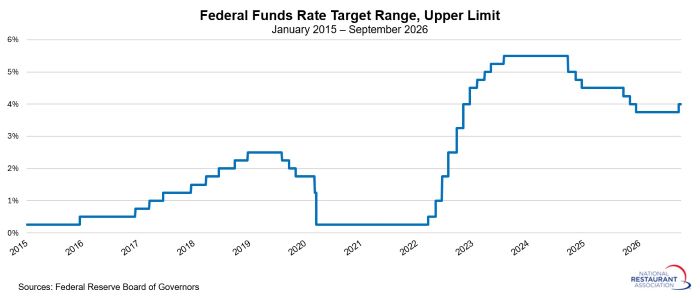
Financial markets had widely anticipated the move. In recent weeks, Federal Reserve Chair Kevin Warsh signaled the central bank's willingness to take appropriate action to preserve price stability, one of the Federal Reserve's dual mandates. The FOMC statement underscored that objective, noting that the higher target range for the federal funds rate should help "support a timelier return to the Committee's 2 percent goal." It went on to state definitively, "The Committee will deliver price stability."
Given the need for the Federal Reserve to stay ahead of inflation, this latest move should help bolster its credibility on the price stability front. Moreover, this may not be the last increase in short-term rates, with the latest economic projections indicating that most FOMC participants expect an additional federal funds rate hike this year.
Beyond inflation concerns, the Federal Reserve also pointed to continued strength in the U.S. economy, describing growth as proceeding at a "solid pace" and highlighting healthy gains in productivity and capital spending. On the labor market, the Fed noted that job growth has "kept pace with the workforce." Even so, policymakers acknowledged that uncertainties remain, particularly surrounding geopolitical developments.
In its economic projections, the median estimate for real GDP growth was revised up modestly to 2.3% in 2026 from 2.2% in the July forecasts, with output expected to increase 2.4% in 2027. The unemployment rate is projected to remain at 4.1% in both 2026 and 2027, a historically solid reading. On inflation, FOMC participants anticipate core inflation of 3.4% in 2026, easing to 2.5% in 2027.
For the restaurant industry, elevated interest rates continue to raise borrowing costs, which can slow expansion plans, renovations, and other capital investments. Higher rates also increase financing costs for franchise development and new unit construction, potentially weighing on industry growth. Should rates remain elevated for an extended period, the combination of more expensive financing and softer business investment could create additional headwinds for restaurants and other hospitality businesses.
Higher interest rates also affect the restaurant sector indirectly through their impact on consumers. As households face higher borrowing costs for credit cards, automobiles, and mortgages, more income is devoted to debt service, leaving less available for discretionary purchases. As a result, sustained rate increases could pose a risk to restaurant traffic and sales growth, particularly if consumers become more cautious in their spending decisions.