Research
September 29, 2026
Restaurant Job Openings
Hospitality labor indicators suggest a low-churn environment
Indicators of labor market activity in the hospitality sector continue to reflect an environment in which both employers and employees are in a wait-and-see mode, which leads to a dampened amount of churn in the workforce.
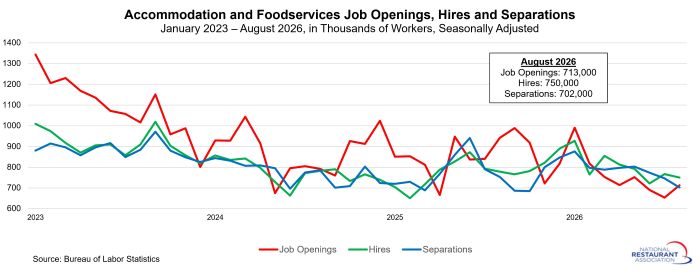
On the last business day of August, there were 713,000 job openings in the combined restaurants and accommodations sector, according to Job Openings and Labor Turnover Survey (JOLTS) data from BLS. That was up from the sub-700k readings in both June and July, but was still well below the nearly 1 million openings at the beginning of the year.
Along with job openings, the number of hires and separations also trended lower in recent months, which is an indication of a low-hire / low-fire mentally among restaurant operators.
Employers in the hospitality sector filled 750,000 positions in August, which was essentially on par with hiring in June and July. The average monthly gain of 746,000 jobs during the 3-month period was down from an average increase of 830,000 jobs during the first five months of 2026.
At the same time, there were only 702,000 total separations in the hospitality sector in August. That was down from 746,000 separations in July and represented the lowest reading since October 2025 (685k).
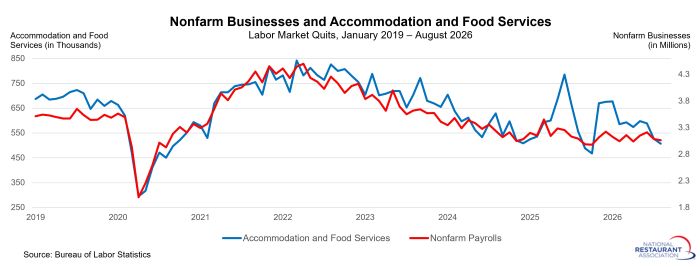
The recent dip in total separations was largely due to the fact that fewer people are quitting their jobs. Quits in the restaurants and accommodations sector numbered just 507,000 in August, which followed 527,000 quits in July. That was down from an average of 603,000 people who quit their jobs each month during the first half of 2026.
Similarly, the quit rate in the overall economy declined in August. Only 3.07 million people quit their jobs in August, the lowest level since April.
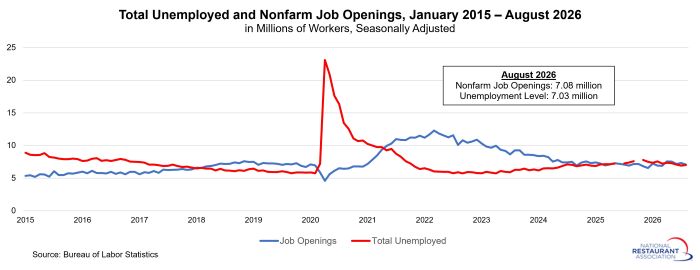
In the overall economy, there were nearly 7.1 million job openings on the last business day of August. That was down from more than 7.3 million openings in July and represented the lowest reading since March.
Job openings were slightly above the number of active job seekers in recent months. August represented the fifth consecutive month that available job openings exceeded the number of unemployed workers, though the most recent gap was only about 50,000 openings.
This represents a normalization of labor market dynamics from the period immediately after the pandemic, when there were significantly more job openings than unemployed workers.
On the last business day of August, there were 713,000 job openings in the combined restaurants and accommodations sector, according to Job Openings and Labor Turnover Survey (JOLTS) data from BLS. That was up from the sub-700k readings in both June and July, but was still well below the nearly 1 million openings at the beginning of the year.
Along with job openings, the number of hires and separations also trended lower in recent months, which is an indication of a low-hire / low-fire mentally among restaurant operators.
Employers in the hospitality sector filled 750,000 positions in August, which was essentially on par with hiring in June and July. The average monthly gain of 746,000 jobs during the 3-month period was down from an average increase of 830,000 jobs during the first five months of 2026.
At the same time, there were only 702,000 total separations in the hospitality sector in August. That was down from 746,000 separations in July and represented the lowest reading since October 2025 (685k).
The recent dip in total separations was largely due to the fact that fewer people are quitting their jobs. Quits in the restaurants and accommodations sector numbered just 507,000 in August, which followed 527,000 quits in July. That was down from an average of 603,000 people who quit their jobs each month during the first half of 2026.
Similarly, the quit rate in the overall economy declined in August. Only 3.07 million people quit their jobs in August, the lowest level since April.
In the overall economy, there were nearly 7.1 million job openings on the last business day of August. That was down from more than 7.3 million openings in July and represented the lowest reading since March.
Job openings were slightly above the number of active job seekers in recent months. August represented the fifth consecutive month that available job openings exceeded the number of unemployed workers, though the most recent gap was only about 50,000 openings.
This represents a normalization of labor market dynamics from the period immediately after the pandemic, when there were significantly more job openings than unemployed workers.