Research
October 02, 2026
Total U.S. jobs
U.S. job growth slowed in September but remained resilient overall
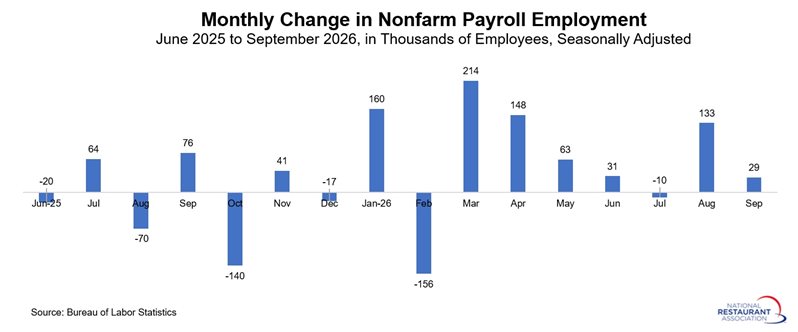
Nonfarm payroll employment increased by 29,000 in September, below expectations but following a gain of 133,000 jobs in August. Even so, payroll estimates for July and August were revised down by a combined 60,000 jobs. Despite the softer September reading, the economy has added jobs in seven of the first nine months of the year, averaging 81,000 new jobs in August and September, roughly matching the consensus forecast for September.
Overall, labor market growth remains resilient despite the disappointing September figure. Continued gains in employment and wages are essential to supporting consumer spending, which remains the primary driver of economic growth.
Restaurant operators are closely monitoring labor market conditions as consumer demand remains cautious. A stable job market should help support spending and restaurant traffic in the months ahead, even as higher gasoline prices and weak consumer confidence present headwinds.
At the same time, downside risks remain elevated amid geopolitical uncertainty and persistent inflation pressures. These crosscurrents continue to complicate the Federal Reserve's policy outlook as officials balance inflation concerns against signs of a moderating labor market. While the Federal Open Market Committee is still expected to raise interest rates once more this year following its September rate hike, the weaker-than-expected September employment report may reduce the likelihood of action at its October meeting, increasing the odds that any additional increase occurs in December.
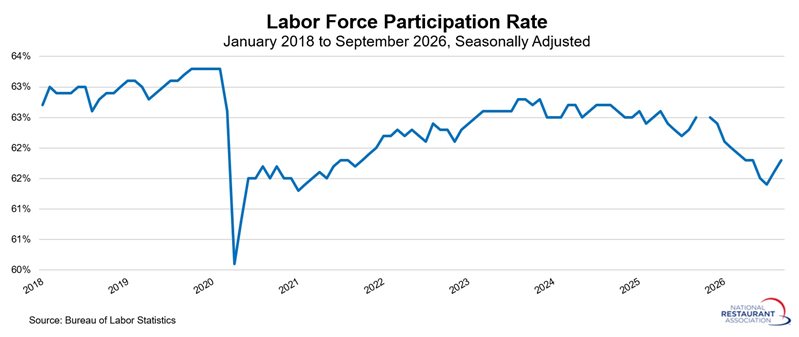
While labor force participation remained subdued, it continued to improve. The labor force participation rate rose to 61.8%, its highest level in four months and up from 61.4% in July.
Even with this recent progress, labor force participation remains below where it stood at the end of last year, highlighting ongoing constraints on labor supply. The participation rate was 62.4% in December, with roughly 1.2 million fewer individuals in the labor force since then. As a result, many employers, including restaurant operators, are likely to continue facing challenges recruiting and retaining workers.
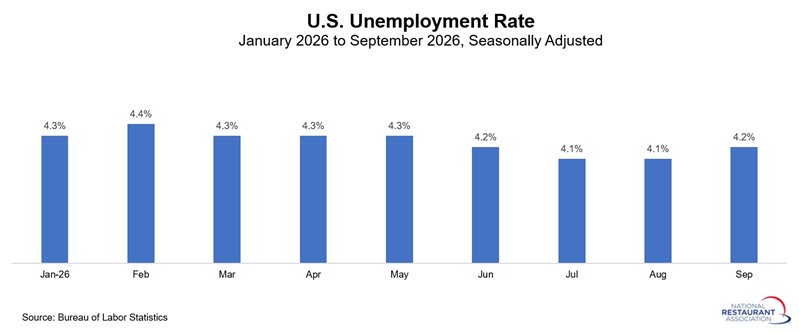
At the same time, the unemployment rate edged up from 4.1% in July and August to 4.2% in September. The number of unemployed individuals rose from 7.03 million in August to 7.11 million in September. Despite the uptick, the labor market remains relatively healthy by historical standards, even with worries about overall participation.
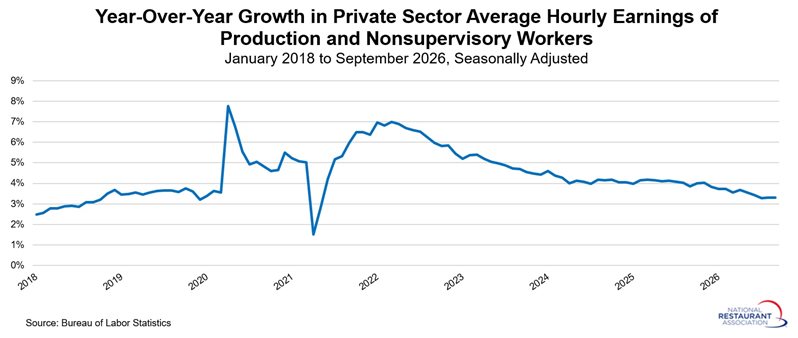
On the wage front, average hourly earnings for private-sector production and nonsupervisory workers increased 0.2% in September to $32.60, rising 3.3% over the past 12 months. Overall, wage growth remains relatively solid by historical standards, suggesting that workers continue to see income gains that can help support consumer spending.
Job growth in September was mixed but also soft. Gains in employment were led by private education and health services; trade, transportation and utilities (including retail trade): construction: leisure and hospitality (including restaurants); and manufacturing. Below is a detailed breakdown of September’s employment changes by sector, ranked from highest to lowest:
Overall, labor market growth remains resilient despite the disappointing September figure. Continued gains in employment and wages are essential to supporting consumer spending, which remains the primary driver of economic growth.
Restaurant operators are closely monitoring labor market conditions as consumer demand remains cautious. A stable job market should help support spending and restaurant traffic in the months ahead, even as higher gasoline prices and weak consumer confidence present headwinds.
At the same time, downside risks remain elevated amid geopolitical uncertainty and persistent inflation pressures. These crosscurrents continue to complicate the Federal Reserve's policy outlook as officials balance inflation concerns against signs of a moderating labor market. While the Federal Open Market Committee is still expected to raise interest rates once more this year following its September rate hike, the weaker-than-expected September employment report may reduce the likelihood of action at its October meeting, increasing the odds that any additional increase occurs in December.
While labor force participation remained subdued, it continued to improve. The labor force participation rate rose to 61.8%, its highest level in four months and up from 61.4% in July.
Even with this recent progress, labor force participation remains below where it stood at the end of last year, highlighting ongoing constraints on labor supply. The participation rate was 62.4% in December, with roughly 1.2 million fewer individuals in the labor force since then. As a result, many employers, including restaurant operators, are likely to continue facing challenges recruiting and retaining workers.
At the same time, the unemployment rate edged up from 4.1% in July and August to 4.2% in September. The number of unemployed individuals rose from 7.03 million in August to 7.11 million in September. Despite the uptick, the labor market remains relatively healthy by historical standards, even with worries about overall participation.
On the wage front, average hourly earnings for private-sector production and nonsupervisory workers increased 0.2% in September to $32.60, rising 3.3% over the past 12 months. Overall, wage growth remains relatively solid by historical standards, suggesting that workers continue to see income gains that can help support consumer spending.
Job growth in September was mixed but also soft. Gains in employment were led by private education and health services; trade, transportation and utilities (including retail trade): construction: leisure and hospitality (including restaurants); and manufacturing. Below is a detailed breakdown of September’s employment changes by sector, ranked from highest to lowest:
- Private education and health services: +20,000
- Trade, transportation, and utilities: +18,000 (retail trade: +5,800)
- Construction: +11,000
- Leisure and hospitality: +10,000 (eating and drinking places: +10,800)
- Manufacturing: +9,000
- Other services: +6,000
- Federal government: -1,000
- Mining and logging: -2,000
- State government: -3,000
- Financial activities: -7,000
- Professional and business services: -9,000
- Information: -10,000
- Local government: -13,000