Research
March 13, 2026
Restaurant Job Openings
An uptick in restaurant job openings suggests a resilient demand for labor
Job openings in the hospitality sector rose in recent months, which suggests the demand for labor remains resilient despite challenging business conditions.
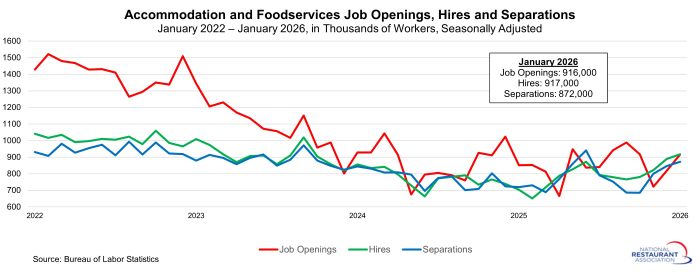
On the last business day of January, there were 916,000 job openings in the combined restaurants and accommodations sector, according to Job Openings and Labor Turnover Survey (JOLTS) data from BLS. That was up from dampened readings in both November (722k) and December (818k).
January’s job openings were back on par with levels reached last summer and fall. On average during the May – October 2025 period, there were roughly 912,000 hospitality job openings each month.
Along with job openings, the number of hires and separations also trended higher in recent months, which indicates an increase in churn within the workforce.
Employers in the restaurants and accommodations sector filled 917,000 positions in January. That was the fourth consecutive monthly increase and represented the largest number of hires since September 2023 (1 million).
There were 872,000 total separations in the restaurants and accommodations sector in January, according to BLS. That represented the highest level since June 2025 (941k).
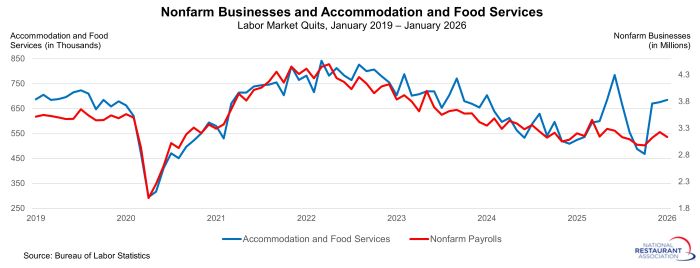
In contrast, the quit rate in the overall economy edged lower in January. The 3.14 million people quitting their jobs in January was down from 3.23 million in December – the highest level in six months.
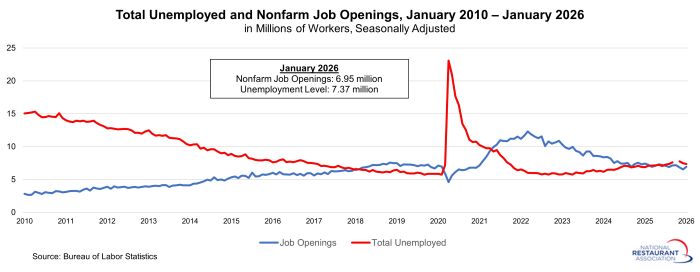
Job openings also dipped below the number of active job seekers in recent months. January represented the sixth consecutive month with data that the number of unemployed workers exceeded available job openings, with a current gap of more than 400,000 workers.
When compared with the 7.4 million unemployed individuals in January, it translates to roughly 94 unemployed workers for every 100 job openings.
This represents a normalization of labor market dynamics from the period immediately after the pandemic, when there were significantly more job openings than unemployed workers.
On the last business day of January, there were 916,000 job openings in the combined restaurants and accommodations sector, according to Job Openings and Labor Turnover Survey (JOLTS) data from BLS. That was up from dampened readings in both November (722k) and December (818k).
January’s job openings were back on par with levels reached last summer and fall. On average during the May – October 2025 period, there were roughly 912,000 hospitality job openings each month.
Along with job openings, the number of hires and separations also trended higher in recent months, which indicates an increase in churn within the workforce.
Employers in the restaurants and accommodations sector filled 917,000 positions in January. That was the fourth consecutive monthly increase and represented the largest number of hires since September 2023 (1 million).
There were 872,000 total separations in the restaurants and accommodations sector in January, according to BLS. That represented the highest level since June 2025 (941k).
In contrast, the quit rate in the overall economy edged lower in January. The 3.14 million people quitting their jobs in January was down from 3.23 million in December – the highest level in six months.
Job openings also dipped below the number of active job seekers in recent months. January represented the sixth consecutive month with data that the number of unemployed workers exceeded available job openings, with a current gap of more than 400,000 workers.
When compared with the 7.4 million unemployed individuals in January, it translates to roughly 94 unemployed workers for every 100 job openings.
This represents a normalization of labor market dynamics from the period immediately after the pandemic, when there were significantly more job openings than unemployed workers.